Artificial Intelligence in Science — A Modern Overview
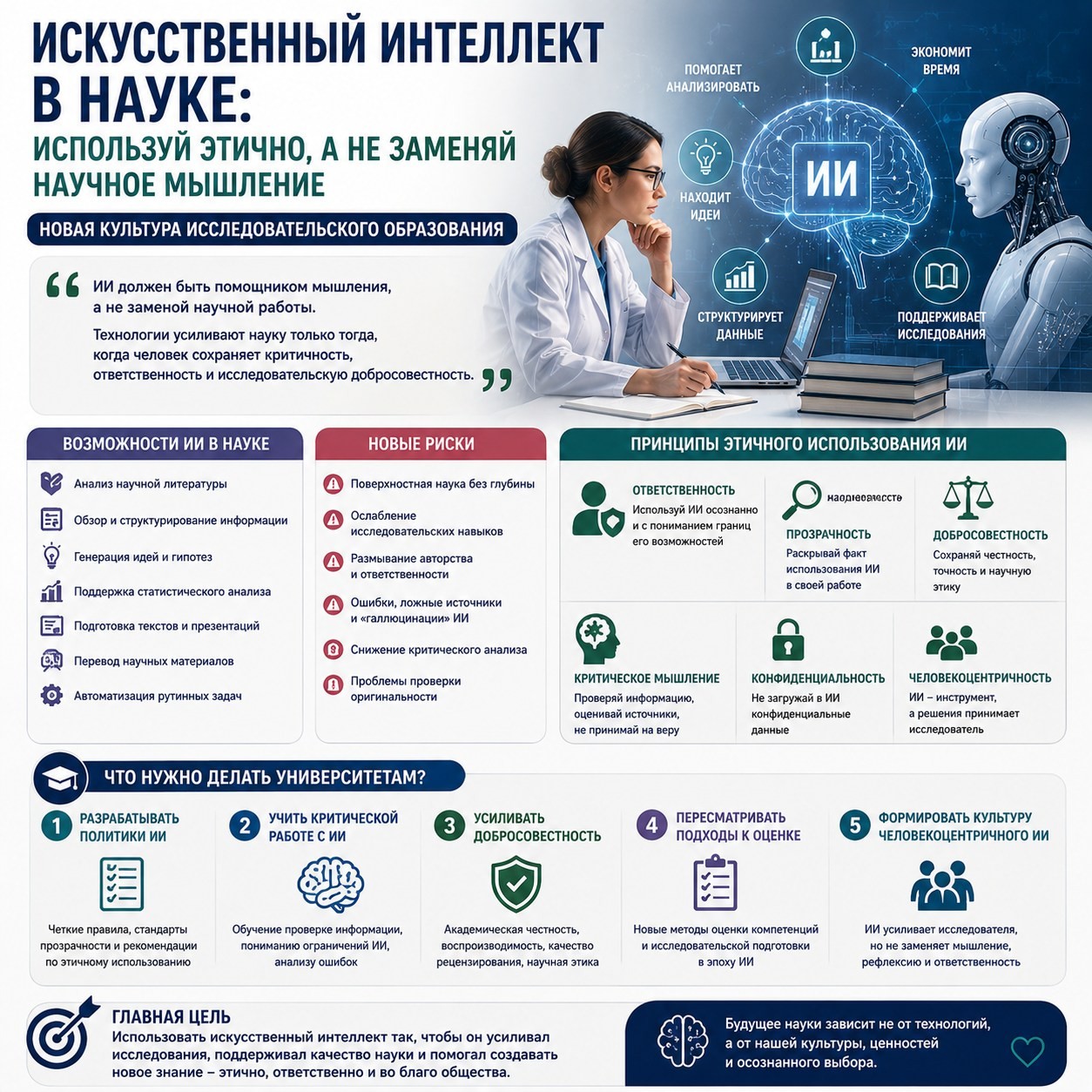
In the context of the rapid development of digital technologies, artificial intelligence (AI) is becoming an integral part of the modern scientific and educational environment. Today, AI is capable of analyzing literature, assisting in writing scientific articles, structuring data, performing statistical analysis, creating presentations, and translating scientific materials. However, along with new opportunities, serious challenges for the academic community are also emerging.
One of the most relevant issues in modern science today is how to use artificial intelligence ethically in research activities without undermining academic integrity, critical thinking, and the culture of scientific inquiry.
In recent years, universities around the world have increasingly faced problems related to the superficial use of AI, automated generation of scientific texts, weakening of academic writing skills, reduced quality of critical analysis, and blurred authorship. Of particular concern are the risks of unreliable information, false references, and errors generated by artificial intelligence systems.
For medical science, this issue is especially significant because the results of biomedical research directly influence clinical decisions, patient safety, diagnostics, and the development of healthcare systems. Therefore, issues of research ethics and the responsible use of digital technologies are becoming priorities for medical universities.
Modern approaches are increasingly based not on banning artificial intelligence, but on developing a culture of its responsible and transparent use. Artificial intelligence should be viewed as a tool that supports researchers’ thinking rather than replacing scientific activity itself.
In this regard, universities face several important tasks:
— developing clear rules and standards for the use of AI;
— teaching students and faculty to critically evaluate information;
— promoting academic honesty and research integrity;
— improving approaches to the assessment of knowledge and competencies;
— fostering a human-centered approach to the use of technologies.
At the Osh International Medical University, it is noted that the development of artificial intelligence requires not only technological adaptation, but also the strengthening of scientific culture based on responsibility, critical thinking, and ethical principles.
The future of science is directly connected with the ability to interact effectively and consciously with digital technologies. Real science is not only about generating text, but above all about thinking, analysis, questioning, searching for new knowledge, and the high responsibility of researchers toward society.
https://www.facebook.com/share/1EzuUB8c7j/
https://www.facebook.com/groups/MedScience/permalink/2746738725693982/?rdid=260aAZOEDyzvVYt5#
https://link.springer.com/article/10.1186/s12909-026-09405-2?fbclid=IwdGRzaASA8uBjbGNrBIDyumV4dG4DYWVtAjExAHNydGMGYXBwX2lkDDM1MDY4NTUzMTcyOAABHsmGSZrXRYAwmYBgkV8pvgwNnPHDYnnWk-eQaiHco2v61xDPcMxsxWit8H1J_aem_DUG0GfQVDXRPT6tSRYmy1A&sfnsn=wa